The useful coffee-storage question is not only “fridge or no fridge?” It is how quickly the beans will be used, how often the container will be opened, and whether air, light, heat, moisture, and surrounding smells can reach them.
Our everyday method is simple: keep a small amount of whole roasted beans sealed in a cool, dark cupboard and grind only what we need. Cold storage is reserved for coffee that will not enter the daily container soon.
Our default for beans in daily use
- Keep the beans whole until brewing.
- Use an airtight, opaque container or a well-sealed suitable coffee bag.
- Choose a cupboard away from the oven, dishwasher, kettle steam, and direct sun.
- Open the container briefly and close it immediately.
- Buy or roast an amount the household can realistically use.
The National Coffee Association's current storage guidance similarly emphasises protection from air, moisture, heat, and light, and recommends small batches, opaque airtight storage, and grinding immediately before brewing.
The refrigerator is not a simple yes or no
A refrigerator is cool, but it is also opened repeatedly and contains food odours and humid air. A frequently opened jar can expose cold beans to condensation. That is why I do not move our daily-use container in and out of the refrigerator.
The National Coffee Association notes that views differ and that humidity changes the calculation. If beans are refrigerated, the container needs to be genuinely airtight and the routine needs to minimise condensation and repeated exposure.
When we divide coffee into portions
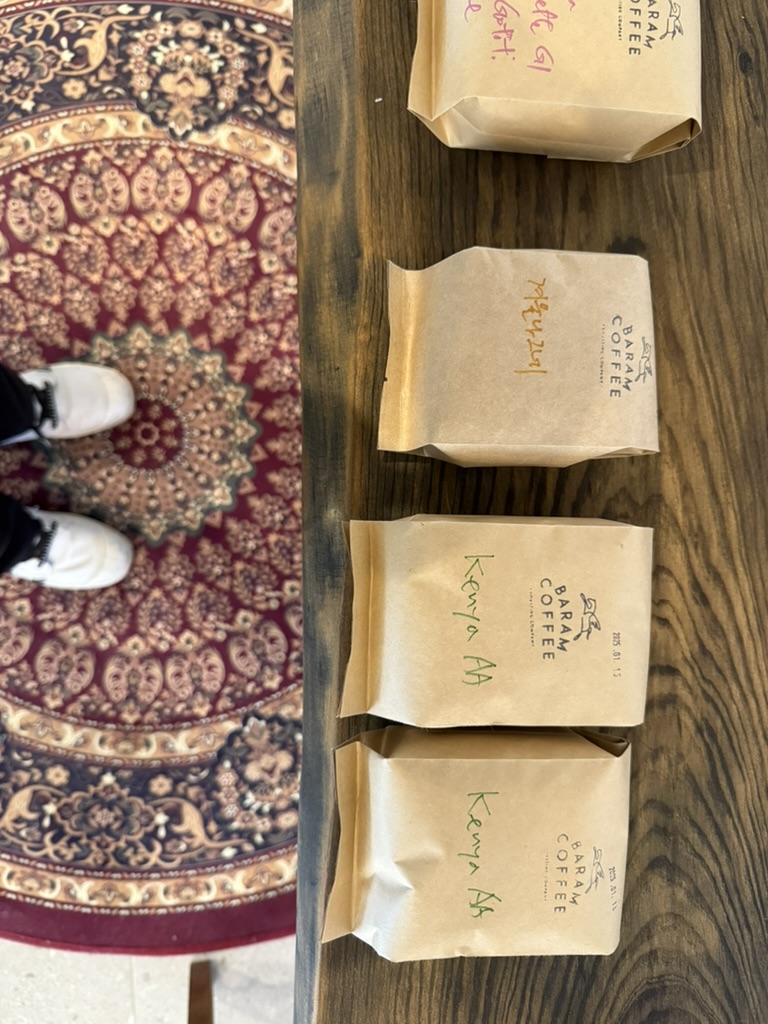
For coffee that will wait longer, smaller sealed portions are more practical than one large container opened again and again. Each portion can be labelled with the bean and date so we do not rely on memory.
The package itself still matters. A folded paper bag is not automatically airtight merely because it looks neatly closed. Long cold storage requires packaging designed to limit air and moisture.
Freezing is for a planned reserve
Freezing can be useful when a sealed portion will not be used soon. It is not our way of holding the jar opened every morning. We portion first, seal carefully, and avoid repeatedly thawing and returning the same batch.
When a frozen portion comes out, condensation is the main practical concern. The package stays sealed while its temperature moves toward the room, so humid air does not immediately reach very cold beans. This is a household quality practice, not a guarantee that every package or freezer behaves identically.
Whole beans and ground coffee are not equivalent
Grinding exposes much more surface area. We therefore store whole beans and grind the amount needed for the next brew rather than keeping an open container of pre-ground coffee beside the machine.
Convenience may matter more in another household, but the trade-off should be visible: pre-grinding saves time while aroma declines faster after the package is opened.
Freshness dates are guides, not magic borders
The association's current consumer table gives roasted beans at room temperature a broad freshness window of roughly one to three weeks when properly stored. Roast style, packaging, opening frequency, and personal taste can shift the useful window, so I do not promise that every coffee peaks on the same day.
A bean that tastes flat is a quality problem. Beans exposed to moisture or showing mold are a different matter and should be discarded. Storage cannot restore aroma that has already disappeared.
The household rule we actually follow
Daily coffee stays cool, dark, sealed, whole, and small in quantity. Reserve coffee is portioned before it goes into cold storage. The refrigerator is not used as a vague symbol of freshness.
That rule gives us fewer containers to open, fewer chances for condensation, and a clearer reason for where each bag is kept.